
Education
OnCourse Connect: Complete Guide to Login, Features, Benefits & Student Portal (2026)

Millas a KM: The Complete Guide
Distance measurement is an essential part of everyday life, whether you are planning a road trip, following GPS directions, studying geography, tracking your fitness progress, or traveling internationally. While many countries use kilometers as their standard unit of measurement, countries such as the United States and the United Kingdom commonly use miles for roads, navigation, and speed limits. This difference often creates confusion for travelers, students, athletes, and professionals who need to understand distances accurately. Searching for millas a km is one of the fastest ways to find reliable conversion information that helps bridge the gap between these two measurement systems.
Understanding how to convert miles into kilometers is more than just memorizing a formula. It allows you to read international maps confidently, compare driving distances between countries, interpret marathon lengths, understand cycling routes, and even analyze weather forecasts that mention travel distances. Whether you are converting one mile or hundreds of miles, knowing the correct conversion method ensures accuracy in every situation.
What Does “Millas a KM” Mean?
The phrase millas a km simply means converting miles into kilometers. A mile is part of the Imperial and US customary systems of measurement, while a kilometer belongs to the metric system used in most countries worldwide. Since both units measure distance, they can be converted using a fixed mathematical relationship.
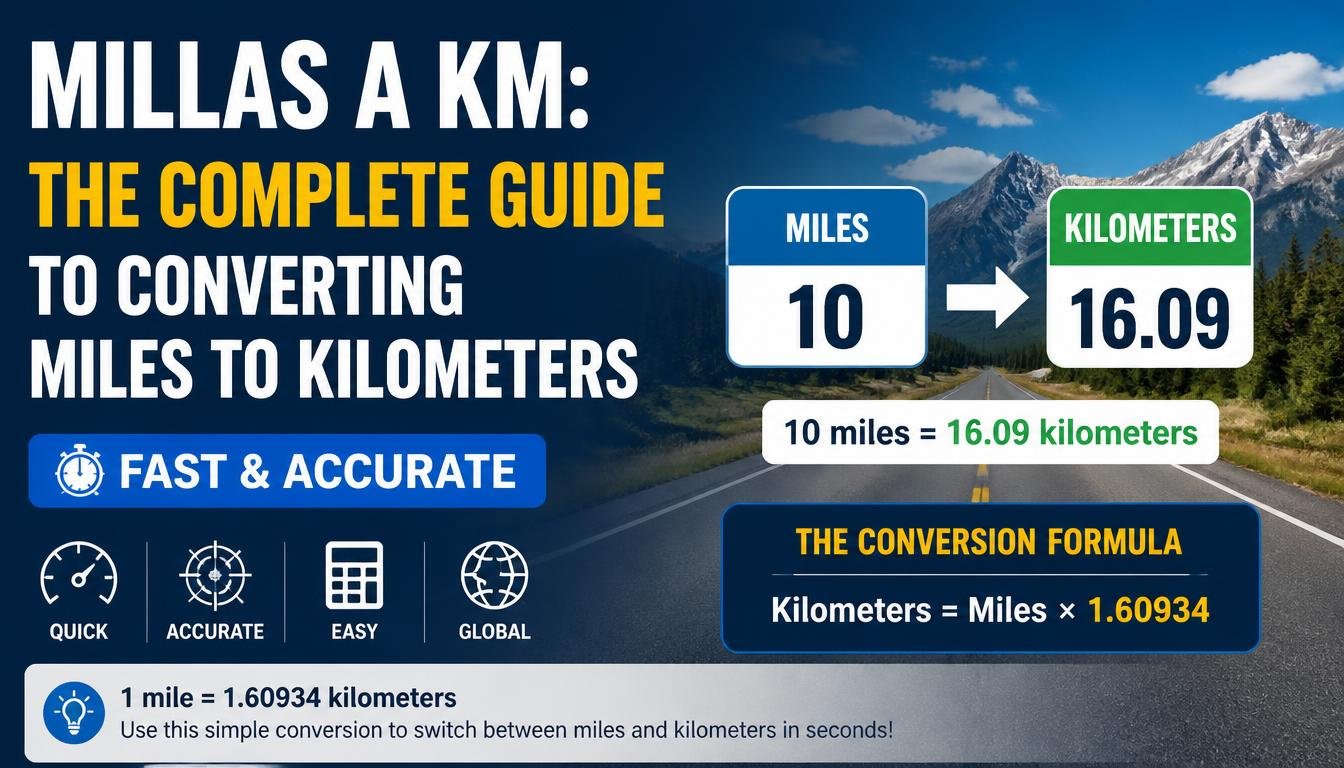
One international mile is exactly equal to 1.609344 kilometers. This internationally recognized standard is used in science, engineering, transportation, aviation, education, and mapping applications around the world.
The Miles to Kilometers Formula
The conversion formula is extremely simple:
Kilometers = Miles × 1.609344
Whenever you know the number of miles, multiply it by 1.609344 to obtain the equivalent distance in kilometers.
Example 1
5 miles × 1.609344 = 8.04672 km
Example 2
25 miles × 1.609344 = 40.2336 km
Example 3
100 miles × 1.609344 = 160.9344 km
Because the conversion factor never changes, this formula works for every distance measurement.
Quick Millas a KM Conversion Chart
| Miles | Kilometers |
|---|---|
| 1 | 1.61 km |
| 2 | 3.22 km |
| 5 | 8.05 km |
| 10 | 16.09 km |
| 20 | 32.19 km |
| 25 | 40.23 km |
| 30 | 48.28 km |
| 40 | 64.37 km |
| 50 | 80.47 km |
| 60 | 96.56 km |
| 75 | 120.70 km |
| 100 | 160.93 km |
| 150 | 241.40 km |
| 200 | 321.87 km |
| 500 | 804.67 km |
This table provides quick reference values without needing to calculate manually.
Why Do Different Countries Use Different Units?
The metric system was developed to provide a universal and standardized way to measure distance, weight, and volume. Today, almost every country in the world uses kilometers for road signs and maps. However, the United States continues to use miles for highways, speed limits, and navigation. The United Kingdom also uses miles on road signs, although many scientific and educational fields there rely on the metric system.
As international tourism and global business continue to grow, converting millas a km has become a common need for millions of people every day.
Common Uses of Miles to Kilometers Conversion
Distance conversion is valuable in numerous real-world situations. Travelers frequently need to convert driving distances when visiting another country. Athletes compare marathon routes, cycling events, and running races that may be listed in either miles or kilometers. Students learn unit conversions in mathematics and science classes, while logistics companies use both systems for shipping and transportation planning. GPS devices and mapping applications also perform these conversions automatically to provide accurate navigation regardless of the country being visited. Understanding the conversion yourself helps you interpret this information more confidently.
How to Convert Millas a KM Without a Calculator
Although calculators make conversions quick, you can estimate distances mentally. A useful trick is to remember that one mile is slightly more than one and a half kilometers. Multiplying by 1.6 instead of 1.609344 gives a close approximation that works well for everyday use. For example, 10 miles is approximately 16 kilometers, 50 miles is about 80 kilometers, and 100 miles is roughly 161 kilometers. While this shortcut is not perfectly precise, it is accurate enough for travel, walking, and general planning.
Miles vs. Kilometers
Although miles and kilometers measure the same thing, they differ significantly in size. One mile is longer than one kilometer, meaning fewer miles are needed to describe the same distance. For example, a road that measures 160 kilometers is approximately 100 miles long. This difference explains why speed limits and driving distances often appear smaller when displayed in miles than when shown in kilometers.
Benefits of Learning Miles to Kilometers Conversion
Learning to convert miles into kilometers improves your understanding of maps, international travel, fitness tracking, sports events, and educational materials. Instead of relying entirely on online tools, you gain the ability to estimate distances quickly in everyday situations. Whether reading an international travel guide, planning a road trip, or participating in a race abroad, this knowledge helps you make informed decisions without confusion.
Common Conversion Mistakes
One of the most frequent mistakes is reversing the formula and dividing instead of multiplying. Another error is assuming that one mile equals one kilometer, which leads to significant inaccuracies over longer distances. Some people also round the conversion factor too aggressively, reducing precision for scientific or engineering calculations. Using the correct factor of 1.609344 ensures accurate results every time.
Conclusion
Converting millas a km is a simple yet valuable skill that benefits travelers, students, athletes, professionals, and anyone working with international distance measurements. By remembering the formula Kilometers = Miles × 1.609344, you can accurately convert any distance from miles into kilometers in seconds. Whether you are planning a vacation, reading a map, tracking your fitness goals, or studying mathematics, understanding this conversion helps eliminate confusion and ensures precise communication across different measurement systems. With the examples, conversion chart, and practical tips provided in this guide, you now have everything you need to convert miles to kilometers confidently and accurately whenever the need arises.
Frequently Asked Questions (FAQ)
What does “millas a km” mean?
It means converting miles into kilometers using the standard conversion factor.
How many kilometers are in one mile?
One mile equals exactly 1.609344 kilometers.
What is the easiest miles to kilometers formula?
Multiply the number of miles by 1.609344.
Is one kilometer longer than one mile?
No. One mile is longer than one kilometer.
Why do most countries use kilometers?
The metric system is internationally standardized, making communication, science, engineering, and transportation more consistent worldwide.
Can I estimate miles to kilometers by multiplying by 1.6?
Yes. Multiplying by 1.6 provides a quick estimate that is suitable for most everyday situations.
Is the conversion factor ever different?
No. One international mile is always equal to 1.609344 kilometers.
Education
Graduation Card Messages: Heartfelt, Inspirational, Funny & Meaningful Wishes for Every Graduate


In today’s digital world, educational institutions are increasingly adopting online systems to provide students with quick and convenient access to academic information. One platform that has gained attention in this area is AttMyResults. Designed to simplify the process of checking exam scores, academic records, and performance updates, AttMyResults serves as a modern result management solution for students who want instant access to their educational achievements. Instead of waiting for physical notices or visiting institutions in person, students can access important information from virtually anywhere with an internet connection. As educational technology continues to evolve, platforms such as AttMyResults play an essential role in improving accessibility, efficiency, and transparency within the academic environment.
What Is AttMyResults?
AttMyResults is an online result portal that allows students to access academic results quickly and efficiently. The platform is designed to eliminate the traditional challenges associated with result distribution, including delays, paperwork, and limited accessibility. By providing a centralized system for academic records, AttMyResults enables students to view their results from computers, tablets, or smartphones at any time.
The platform focuses on user convenience and accessibility. Students no longer need to travel to educational institutions or wait for printed result sheets. Instead, they can simply log in to the portal and retrieve the information they need. This streamlined process saves time while ensuring that academic records remain organized and easy to access. For educational institutions, the platform can also help reduce administrative workloads and improve communication with students.
Key Features of AttMyResults
One of the major reasons why AttMyResults attracts users is its range of practical features. The platform is built with the needs of students and educational organizations in mind, offering a reliable environment for result management.
A key feature is instant result access. Students can check their exam results immediately after publication without waiting for physical distribution. The portal also provides secure login functionality that helps protect sensitive academic information. Security is particularly important because educational records contain personal and confidential data that must remain protected from unauthorized access.
Another valuable feature is mobile compatibility. Modern students frequently use smartphones for academic activities, and AttMyResults supports convenient access across multiple devices. The platform’s user-friendly interface further improves the experience by making navigation simple and intuitive. Even individuals with limited technical knowledge can usually locate their results quickly and efficiently.
Benefits of Using AttMyResults
The benefits of AttMyResults extend beyond convenience. Students gain immediate access to important academic information, allowing them to evaluate their performance and make informed decisions about their educational goals. Faster access to results can help students prepare for future examinations, applications, or academic planning activities without unnecessary delays.
Educational institutions also benefit from the automation provided by digital result management systems. Administrative staff spend less time handling result inquiries and distributing documents manually. As a result, resources can be allocated more effectively toward educational support and student services. Furthermore, digital record management helps improve accuracy and reduces the risk of lost or damaged paperwork.
The availability of results online contributes to greater transparency as well. Students can independently verify their scores and academic progress whenever necessary. This level of accessibility encourages accountability and helps build trust between educational institutions and students.
How to Access Results Through AttMyResults
Accessing results through AttMyResults is generally a straightforward process. Students begin by visiting the portal and entering their login credentials. Once authenticated, users can navigate to the results section, where available examination records and academic reports are displayed. Depending on the institution’s implementation, students may be able to download result documents, print copies for official purposes, or review historical academic data.
The process is designed to be efficient and user-friendly. Clear navigation menus and organized result categories help users find information without confusion. For students who regularly monitor academic progress, the ability to access results quickly can be extremely valuable throughout the academic year.
Why Online Result Portals Are Important
Online result portals such as AttMyResults represent a significant advancement in educational technology. Traditional result distribution methods often involve long waiting periods, administrative bottlenecks, and accessibility challenges. Digital platforms address these issues by providing instant access to information while maintaining security and accuracy.
The increasing adoption of online education and digital services has made result portals more relevant than ever. Students expect convenient access to educational resources, and institutions seek efficient ways to deliver information. As a result, platforms like AttMyResults help bridge the gap between academic administration and modern technological expectations.
Furthermore, online result systems support sustainability initiatives by reducing paper consumption. Digital records can be stored, managed, and retrieved electronically, contributing to environmentally responsible practices while improving operational efficiency.
Common Issues and Troubleshooting Tips
While AttMyResults is designed for ease of use, users may occasionally encounter technical issues. Forgotten passwords are among the most common challenges. In such situations, students can typically use the password recovery feature to regain account access. Connectivity problems may also affect access, making it important to ensure a stable internet connection when checking results.
If results are unavailable, users should verify whether the institution has officially released them. Sometimes delays occur due to administrative updates or scheduled publication dates. Clearing browser cache, updating browsers, and using compatible devices can also help resolve technical difficulties. When problems persist, contacting the relevant support team is usually the best course of action.
The Future of Digital Result Management
As technology continues to evolve, digital result management platforms are expected to become even more advanced. Future improvements may include artificial intelligence-powered analytics, personalized academic insights, automated notifications, and enhanced security features. These innovations could provide students with deeper understanding of their academic performance while simplifying administrative processes for institutions.
AttMyResults represents part of a broader movement toward digital transformation in education. The demand for faster, more secure, and more accessible academic services continues to grow, encouraging ongoing development and innovation within the educational technology sector.
Conclusion
AttMyResults is an important example of how technology is transforming educational administration and student services. By providing quick access to academic results, improving convenience, enhancing security, and reducing administrative burdens, the platform offers significant value to both students and institutions. As digital education solutions continue to expand, result portals like AttMyResults will likely become an essential component of modern academic environments. Students seeking efficient access to their exam records and educational achievements can benefit greatly from the accessibility and functionality offered by such platforms.
Frequently Asked Questions (FAQ)
1. What is AttMyResults?
AttMyResults is an online platform that enables students to access academic results and examination records through a digital portal.
2. How do I log in to AttMyResults?
Users typically log in using credentials provided by their educational institution, such as a username, student ID, or password.
3. Can I check my results on a mobile device?
Yes, AttMyResults is generally designed to be accessible on smartphones, tablets, and desktop computers.
4. Is AttMyResults secure?
The platform usually incorporates secure login systems and data protection measures to safeguard academic information.
5. What should I do if I forget my password?
Most portals provide a password recovery or reset option that allows users to regain access to their accounts.
6. Why can’t I see my results?
Results may not yet be published, or there could be technical or account-related issues. Checking with the institution is often recommended.
7. Can I download or print my results?
Many online result systems allow students to download or print result reports for personal or official use.
8. What are the main benefits of AttMyResults?
The primary benefits include convenience, fast access to results, improved transparency, secure record management, and reduced administrative delays.

Domino’s Extravaganza: Complete Guide to the Popular Loaded Pizza

KT Tape Shoulder Rotator Cuff: How to Tape for Support and Pain Relief

Elle Brooke Dredd: Who Are They and What Does the Search Term Mean?

Katie Holmes and Joshua Jackson: Their Hollywood Journey, Connection, and Career Highlights

Pedro Vaz Paulo: Leadership, Business Strategy, and Professional Excellence

Belgium De Bruyne: Career, Achievements, Playing Style and Football Legacy
 Celebrity3 months ago
Katie Holmes and Joshua Jackson: Their Hollywood Journey, Connection, and Career Highlights
- Business3 months ago
Pedro Vaz Paulo: Leadership, Business Strategy, and Professional Excellence
- Celebrity3 months ago
Belgium De Bruyne: Career, Achievements, Playing Style and Football Legacy
- News3 months ago
Sea Isle News: Latest Local Updates, Events, Weather, and Community Stories
- Tech3 months ago
MindArk Entropia: The Complete Guide to the World’s Most Unique Virtual Economy
- Tech3 months ago
Mazda CX-5 2025: Complete Review, Specs, Features, Price, Performance, and Buying Guide
- Entertainment3 months ago
Brewzle: The Complete Guide to Everything You Need to Know
- Business2 months ago
Sportsman’s Warehouse Store Closures: Everything You Need to Know About Store Shutdowns, Business Strategy, and Future Growth